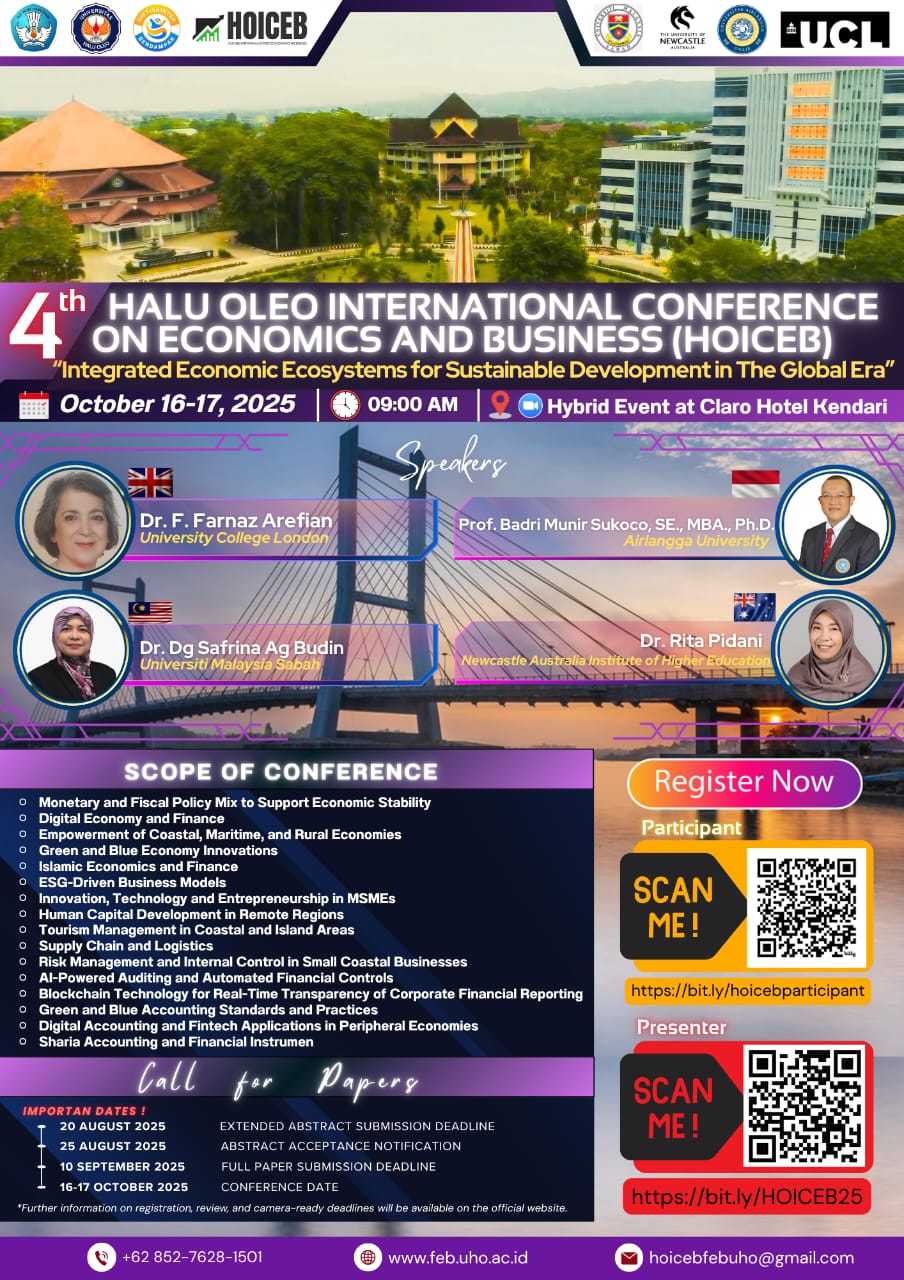
Enhancing Human Capital Development in Remote Regions through Digital Literacy: The Mediating Effect of Entrepreneurial Mindset
Keywords:
Digital Literacy, Entrepreneurial Mindset, Human Capital Development, Remote RegionsAbstract
Human capital development in remote regions is a crucial factor in fostering inclusive and sustainable economic ecosystems, particularly in the global era where competitiveness is increasingly determined by knowledge, skills, and innovation. However, communities in remote areas often face barriers such as limited access to education, digital infrastructure, and entrepreneurial opportunities, which hinder their active participation in broader economic networks. This study aims to analyze the effect of digital literacy on human capital development, with an entrepreneurial mindset as a mediating variable. The research objects are Papuan students at Universitas Cenderawasih who have taken entrepreneurship courses, as they are considered to possess fundamental knowledge of entrepreneurship and have gained practical experience through campus programs such as entrepreneurship bazaars. The study involved a population of 220 students, with a total sample of 142 respondents determined using Slovin’s formula. A quantitative approach was employed, and data were collected through structured questionnaires and analyzed using SmartPLS to test both direct and indirect relationships in the proposed structural model. The results indicate that digital literacy has a significant positive impact on human capital development, while the entrepreneurial mindset serves as a mediating variable that strengthens this relationship. These findings highlight that enhancing an entrepreneurial mindset is a strategic pathway to maximize the impact of digital competencies on sustainable human capital development in remote regions. The study contributes to the literature on human capital development in emerging economies and provides practical insights for policymakers and educators in designing more targeted development programs for academic communities in remote areas.
References
Amiri, S. M. H. (2025). The Digital Divide Revisited: Connectivity, Devices, and the Hidden Barriers to Global EdTech Equity. Indonesian Journal of Innovation and Applied Sciences (IJIAS), 5(3), 254-267.
Badan Pusat Statistik. (2023). Profil kemiskinan di Indonesia Maret 2023. BPS RI.
Boseke, R. E., & Meiryani, M. (2025). Strategic entrepreneurship mediating the impact of financial literacy and use of social media on MSMEs’ entrepreneurial orientation in Indonesia. Journal of Entrepreneurship and Business, 6(1), 1–19.
Chin, W. W., Marcolin, B. L., & Newsted, P. R. (2008). A partial least squares latent variable modeling approach for measuring interaction effects: Results from a Monte Carlo simulation study and an electronic-mail emotion/adoption study. Information Systems Research, 14(2), 189–217.
Colombelli, A., Loccisano, S., Panelli, A., Pennisi, O. A. M., & Serraino, F. (2022). Entrepreneurship education: The effects of challenge-based learning on the entrepreneurial mindset of university students. Administrative Sciences, 12(1), 10.
Crosina, E., Frey, E., Corbett, A., & Greenberg, D. (2024). From negative emotions to entrepreneurial mindset: A model of learning through experiential entrepreneurship education. Academy of Management Learning & Education, 23(1), 88–127.
Derre, J. (2024). Innovation and creativity as pillars of human capital development. Journal of Innovation and Knowledge, 9(1), 33–48.
Eshet-Alkalai, Y., & Chajut, E. (2020). You can teach old dogs new tricks: The factors that affect changes over time in digital literacy. Journal of Information Technology, 35(1), 45–63.
Fornell, C., & Larcker, D. F. (1981). Evaluating structural equation models with unobservable variables and measurement error. Journal of Marketing Research, 18(1), 39–50.
Hagabean, A., Budiman, A. N., & Raousydiy, R. (2023). Entrepreneurial literacy development program for Generation Z student of Madrasah Aliyah. Journal of Entrepreneurship and Community Innovations (JECI), 2(1), 35–45.
Hair, J. F., Risher, J. J., Sarstedt, M., & Ringle, C. M. (2019). When to use and how to report the results of PLS-SEM. European Business Review, 31(1), 2–24.
Handayati, P., Wulandari, D., & Puspitasari, N. (2020). Experiential learning in entrepreneurship education. Education + Training, 62(5), 559–572.
Hatlevik, O. E., & Christophersen, K. A. (2023). Digital responsibility and students’ online safety skills. Computers & Education, 196, 104687.
He, J., Chen, Y., Zhou, Y., Zhang, Y., & Wang, B. (2025). The relationship between entrepreneurial psychological capital and entrepreneurial persistence: Evidence from China. Journal of Entrepreneurship in Emerging Economies, 17(5), 1311–1331.
Henseler, J., Ringle, C. M., & Sarstedt, M. (2015). A new criterion for assessing discriminant validity in variance-based structural equation modeling. Journal of the Academy of Marketing Science, 43(1), 115–135.
Hoti, A., Kasap, S., & Malaj, A. (2024). Fostering entrepreneurial mindset in students: A modular framework for integrating entrepreneurship education into engineering capstone projects. Journal of Educational and Social Research, 14(1), 32–32.
Husnah, E. M., Winarno, A., & Wardana, L. W. (2025). The role of digital literacy and entrepreneurship literacy mediated by entrepreneurship education on digital business skills of vocational students in Malang Regency. Journal of Educational Analytics, 4(1).
Ibáñez, J., & Véliz Palomino, J. (2024). Creativity and innovation as drivers of entrepreneurial mindset. Journal of Entrepreneurship in Emerging Economies, 16(2), 225–244.
Kushwah, S., Dhir, A., & Sagar, M. (2024). Opportunity recognition and entrepreneurial action in emerging markets. Journal of Business Venturing Insights, 21, e00412.
li, M. (2021). A revised agenda for training of women entrepreneurs in digital literacy. Academia Letters.
Lim, Y. (2023). Exploring female entrepreneurship: Focusing on entrepreneurial intention and entrepreneurial experience. Academy of Entrepreneurship, 4(1), 55–77.
Lin, Z., Ryskulova, B., Cheng, X., Ren, S., & Apaeva, S. K. (2024). Critical thinking development of foreign language teachers through digital literacy training. Journal of Educational Technology Development and Exchange, 17(1), 222–236.
Mehdizadeh, H., Shiri, N., & Khoshmaram, M. (2020). Entrepreneurial opportunity recognition capacity among agriculture students at Ilam University. Journal of Entrepreneurial Strategies in Agriculture, 7(13), 78–86.
Msimango-Galawe, J. (2022). The impact of business development support training on youth entrepreneurship success in South Africa: A case study of the Gauteng Province. Journal of Entrepreneurial Innovations, 2(1).
Mthanti, T., & Ojah, K. (2018). Institutions, human capital and entrepreneurial orientation: Implications for growth policy. Journal of Entrepreneurship and Public Policy, 7(2), 135–160.
Munir, H., Jianfeng, C., Miao, W., & Ramzan, S. (2019). Human capital and theory of planned behavior: Unraveling entrepreneurial intentions of IT students in Pakistan. Journal of Entrepreneurship and Business Innovation, 6(2), 23–23.
Muzanenhamo, A., & Mkansi, M. (2023). A Human Capital Perspective on Behavioral Factors Affecting Customers’ Acceptance of Crowd Logistics: A Systematic Literature Review. Indonesian Journal of Innovation and Applied Sciences (IJIAS), 3(3), 210-217.
Nabi, G., Liñán, F., Fayolle, A., Krueger, N., & Walmsley, A. (2019). The impact of entrepreneurship education on entrepreneurial intentions. Academy of Management Learning & Education, 18(1), 39–61.
Nambie, N. B., Ocansey, E. O. N. D., & Ababio, O. K. (2025). Economic transformation and financial literacy: Impacts on human capital development in Africa. African Journal of Economics and Sustainable Development, 8(2), 17–34.
Nasir, N. (2025). Analysis of economic literacy and business capital on entrepreneurial decisions in street vendors in the field Karebosi Makassar. Journal of Entrepreneurship, 3(3), 63–71.
Neumeyer, X., & Santos, S. C. (2022). The entrepreneurial mindset in the digital context: A conceptualization and research framework. Academy of Management Proceedings, 2022(1).
Ng, W. (2021). Digital literacy: Conceptual framework for the digital age. Educational Technology Research and Development, 69(3), 1245–1268.
Noh, N. M., Othman, N., & Rahman, R. S. A. R. A. (2024). Challenges of community college students in mastering entrepreneurial mindset. Advanced International Journal of Business, Entrepreneurship and SMEs, 6(20), 19–28.
Nurkholis, N. (2018). Pendidikan formal dan pembangunan SDM di era digital. Jurnal Pendidikan Indonesia, 7(2), 145–156.
Paudel, U. R. (2025). Skills training and youth employability in developing countries. International Journal of Training and Development. Advance online publication.
Pham, T. H., Do, B. R., & Luu, T. M. (2024). Entrepreneurial risk tolerance and innovation behavior among students. Journal of Small Business Management, 62(1), 118–135.
Redecker, C. (2019). European framework for the digital competence of educators. Publications Office of the European Union.
St-Jean, E., Tremblay, M., & Chouchane, R. (2021). Back into entrepreneurship: Entrepreneurial mindset of experienced entrepreneurs. Academy of Management Proceedings, 2021(1), 15491.
UNESCO. (2022). Global education monitoring report: Technology in education. UNESCO Publishing.
van Laar, E., van Deursen, A., van Dijk, J., & de Haan, J. (2020). Determinants of 21st-century digital skills: A large-scale survey among working professionals. Computers in Human Behavior, 100, 93–104.
Wei, Y., & Wang, M. S. (2019). Corruption and entrepreneurial firm performance: The moderating role of mindset and social capital. Academy of Management Proceedings, 2019(1), 14166.